TL;DR: Summertime Pools specifies a cartridge filter as standard on every pool it builds. Cartridge filters clean to 10-15 microns, use no backwash water, and need no sewer connection. For most Australian homeowners, cartridge wins on water clarity, water efficiency, ease of maintenance, and clean integration with the HushHub Control equipment system. If you are replacing sand media, glass is a solid upgrade - but come prepared with a plan for disposal when the media eventually needs changing.
Most pool buyers spend hours choosing a shell shape, a colour, and a finish. The filter barely rates a mention. That is a mistake.
The filtration system is the heart of the pool. Get it right and your water stays clear with minimal effort. Get it wrong and you are fighting chemistry problems, cloudy water, and expensive service calls for the life of the pool.
Barry Mackay has been fitting and advising on pool equipment at Summertime Pools for over 25 years. His view is clear: for the residential pools Summertime builds, a cartridge filter is the right choice in almost every situation. This article explains why, and gives you the full comparison so you can make a confident, informed decision.
How Pool Filtration Works
Every pool runs water through a three-stage filtration process before returning it to the pool. First, the skimmer basket at the pool wall traps leaves and large surface debris. Second, the pump basket catches the finer material that gets past the skimmer. Third, the main filter captures what remains before the water moves on to heating and chemical treatment.
It is that third stage, the main filter, where the choice between cartridge, sand, and glass media actually matters.
The Three Filter Types at a Glance
| Feature |
Cartridge |
Sand |
Glass Media |
| Filtration rating |
10–15 microns |
20–40 microns |
5–15 microns |
| Water clarity |
Can maintain crystal clear water when properly maintained |
Can maintain pool water crystal clear when properly maintained |
Can maintain clean water when properly maintained |
| Backwash required |
No |
Yes |
Yes |
| Sewer connection needed |
No |
Yes (urban areas) |
Yes (urban areas) |
| Water lost per clean |
Minimal (hose rinse) |
~960L per backwash |
~960L per backwash |
| Filter media / replacement |
Every 2–3 years |
Every 5 years |
Every 7–10 years |
| Physical footprint |
Compact |
Large (24–28 inch tank) |
Large (24–28 inch tank) |
| HushHub compatible |
Yes – designed for it |
Requires adjustment |
Requires adjustment |
Note: Diatomaceous Earth is another option; a DE filter can deliver superior water clarity, but it needs more maintenance.
Cartridge Filters: Summertime's Standard Choice
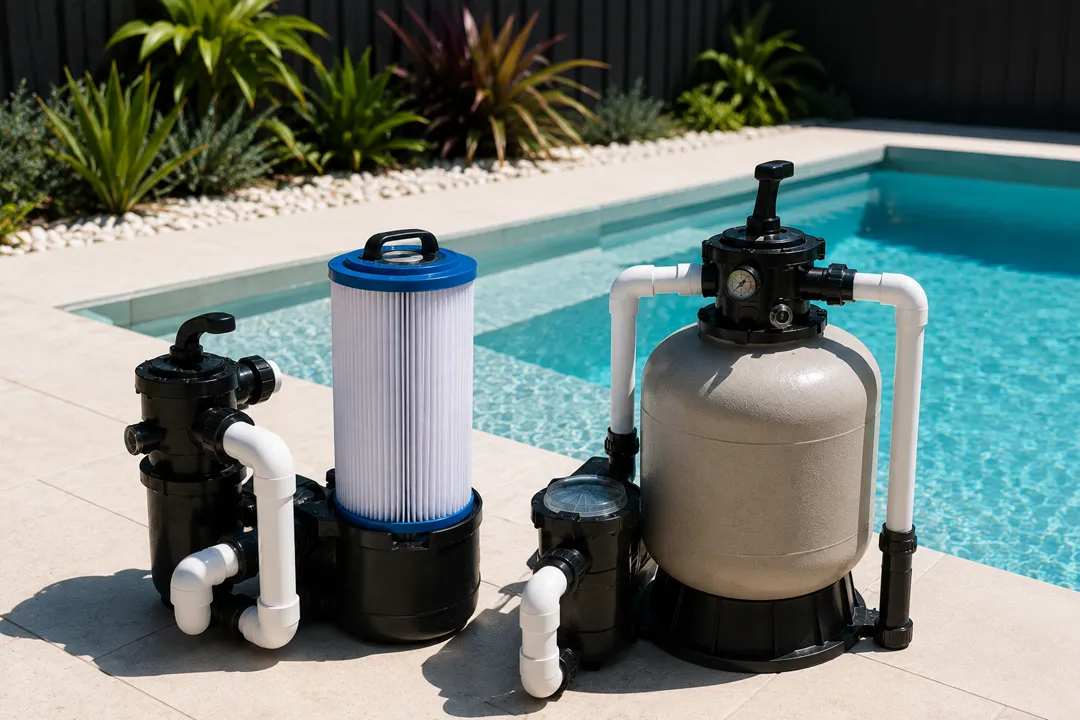
For most residential pool owners, cartridge filters are a suitable choice because both filter types can effectively maintain clean water and crystal clear conditions. Summertime specifies a 200 square foot cartridge filter on every pool it builds. That single specification covers the full range, from a 15,000 litre plunge pool to a 60,000 litre family pool, paired with a 1.25 horsepower variable speed pool pump.
Cartridge filters work by pushing water through a pleated polyester element coated with filter media and designed to capture tiny particles down to 10 to 15 microns. When the filter loads up, you remove the cartridge, rinse it with a hose, soak it in filter cleaner if needed, and refit it. No water is discharged to the sewer. No plumber is involved. No multi-port valve to operate. It also works with the pump at lower flow, making it more energy efficient than backwashing systems.
The pressure gauge on the outside of the filter housing tells you when it is time for a clean. The gauge reading climbs as the cartridge loads. That is the only diagnostic you need.
Barry's tip: Buy a spare cartridge. For around $200, you can swap the dirty cartridge straight out and put the clean one in immediately. The dirty one goes into a bucket of filter cleaner and is ready for next time. No downtime, no waiting around while your pool runs unfiltered.
For new builds in particular, expect to clean the filter more in the first 12 to 18 months. Construction dust, landscaping, and any building activity nearby blow fine particles into the pool and the cartridge catches all of it. That is exactly what it is designed to do. Once the yard is established and the estate settles, most owners find a fortnightly to monthly cleaning routine, depending on bather load. Diatomaceous Earth filters provide superior water clarity, but cartridge systems still keep pool water crystal clear with less fuss and a smaller footprint.
Cartridge elements typically last 2 to 3 years with regular cleaning and proper chemical balance. Deep clean them 1 to 2 times a year, then replace them when worn. The housing lasts far longer. When the element does need replacing, it is a straightforward swap you can do yourself in under ten minutes, which helps keep the system efficient.
The Cartridge Filter and the HushHub Equipment System
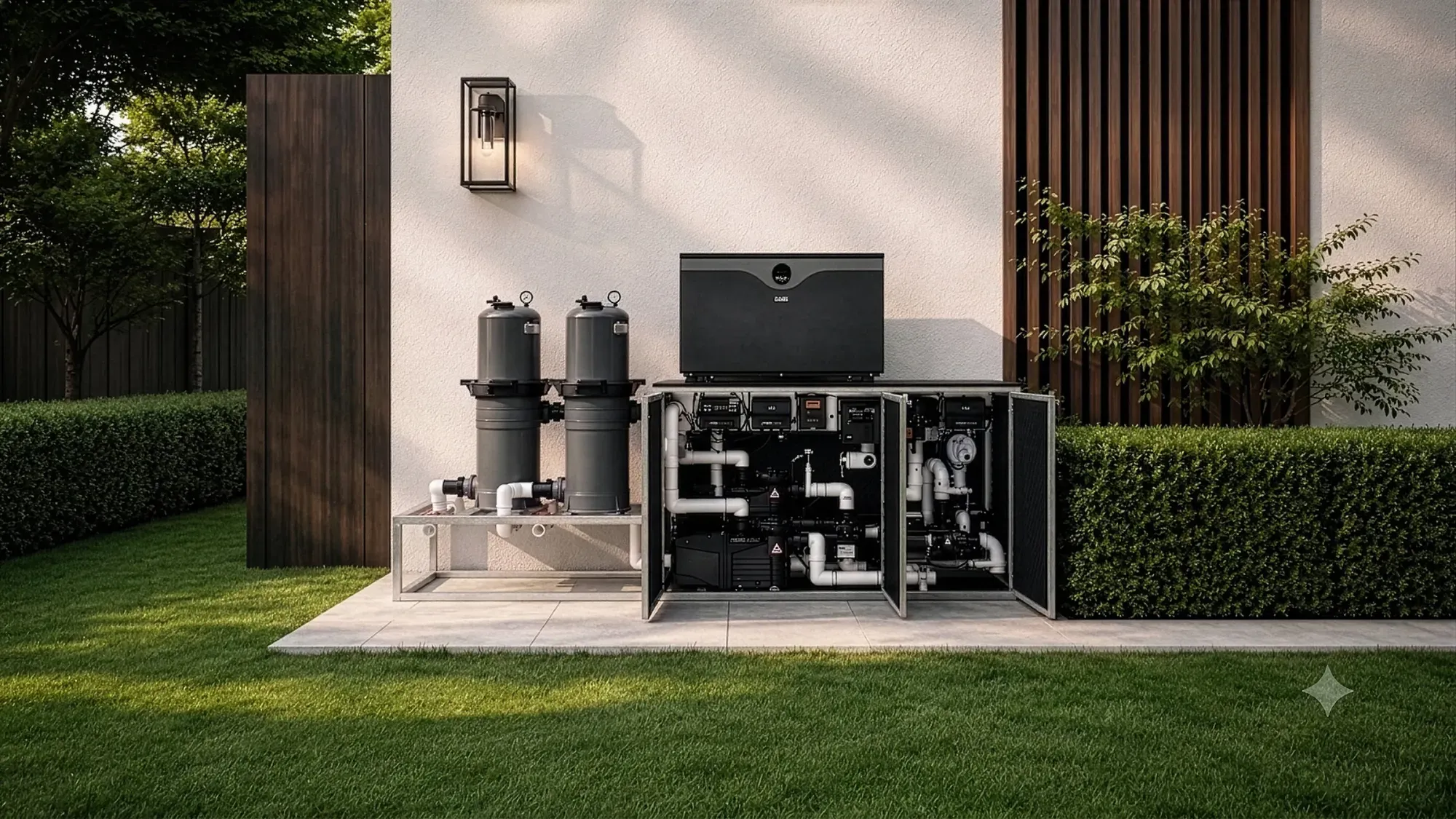
The HushHub is Summertime's proprietary equipment system. The pump, filtration, sanitisation, and heating components arrive at your home pre-plumbed, pre-wired, and pre-configured inside an acoustic enclosure. It sits beside the house like an air conditioning condenser, and the compact cartridge setup gives it a smaller footprint.
The acoustic enclosure houses the components that generate noise: the pump, the controllers, the electrics. The cartridge filter sits on the outside of the frame, at eye level, without tools required for access. This placement is deliberate. For pool owners, the outside position makes it easier to maintain the filter, check the pressure gauge at a glance, pull the cartridge in seconds, and keep the swimming pool running cleanly; cartridge filters also usually need a deep clean just 1-2 times a year.
A sand or glass media filter is a 60 to 72 cm cylindrical tank. The comparison is apt: they look like the gas cylinders on a barbecue. They are bulky, less suitable where space-efficient integration matters, sit beside the HushHub rather than integrating with it, and the multiport backwash valve adds another failure point to manage. The compact footprint of the cartridge filter is one of the reasons it suits the HushHub design so well.
Sand Filters: The Old Reliable With a Modern Problem
Sand filters work by pushing water through a bed of pool filter sand at 20 to 40 microns, then reversing the flow to flush trapped debris out through a backwash valve. They remain a cost effective option for many larger residential pools because the sand bed captures dirt and other unwanted particles, just at a coarser micron range than cartridge. In urban areas, that discharge must connect to the house sewage system, which requires a licensed plumber to install the waste line. In rural areas without sewer access, regulations require a dedicated backwash drain filled with appropriate drainage material.
The water cost adds up fast. Backwashing a 50,000 litre pool takes around 3 minutes at 320 litres per minute: roughly 960 litres of treated pool water discharged every time the filter needs cleaning. Do that once a month and you are losing close to a thousand litres of treated, chemically balanced water every four weeks. Repeated backwashing can also make it harder to keep pool water crystal clear unless you top up and rebalance chemicals.
There is also a maintenance trap that catches many sand filter owners. If you backwash while the pump basket or skimmer basket is dirty, fine particles can be forced into the lateral assembly inside the filter tank. You cannot see this happening from the outside. The result is a blocked lateral system that requires pulling the entire filter apart to fix - a service job that typically runs over $1,000.
Sand media needs replacing every five years. A technician comes out, opens the filter, pumps the old sand into your yard or a trailer, and refills it. Sand is biodegradable and the tip will take it, but the process is messy and involves a cost and a professional visit you need to organise.
Like most pool sand filters, sand comes with real pros and cons. It is still used widely, and whether it is the best pool filter really comes down to your priorities: lower upfront cost or finer filtration. But for a residential pool where water efficiency, ease of use, and compact equipment matter, the cartridge filter has clear advantages.
Glass Media: Premium Upgrade or Expensive Upsell?
Glass media filters to 5 to 15 microns, finer than sand, and lasts 7 to 10 years before the media needs replacing. In pool filter systems, it is another type of filter media and requires less frequent backwashing than sand, while not accumulating the mineral buildup that accelerates sand degradation over time.
Glass media was not originally designed as a universal upgrade. It came into the market specifically to address a problem with magnesium mineral pool systems. When magnesium is used as part of the water treatment process, it can settle on top of standard sand beds and create an overly fine filtration layer, causing the filter to block faster than expected. Glass media was introduced as the technical solution for those pools. Over time it became a general premium upsell across the industry.
If you are using a sand-style media filter and want to upgrade, glass is a worthwhile improvement: better filtration, a more efficient capture of fine particles than sand, longer lifespan, less frequent backwashing. But it comes with a disposal question that the industry has not fully answered.
When a glass media filter tank splits, or the media reaches end of life, what do you do with it? You cannot put it in a customer's backyard. It is not biodegradable, it is not accepted at most tips as standard green waste, and no clear collection or recycling pathway exists for residential pool glass media. Barry: "One day, that question needs to be answered. There has to be a legal solution."
Many experienced pool operators are recommending sand again for exactly this reason. Sand is cheaper, performs well, and when the media is spent the disposal answer is simple. Glass media makes sense for specific use cases. As a blanket upsell, it is worth scrutinising.
Water Clarity: Will You Actually See the Difference?
The honest answer: probably not, if all three systems are properly maintained and running at the correct filtration times. Both cartridge and sand filters can keep a swimming pool clean and clear. The average pool owner with a well-serviced filter of any type will have clean water.
What Barry notices after years of site visits is that cartridge pools have a more vibrant look to the water, particularly around the return jets. Sand and glass media pools that are getting close to needing service often have a subtle dullness to the water colour and a faint cloud coming back through the returns. A filter using diatomaceous earth can capture finer filter particles and leave pool water crystal clear by trapping smaller contaminants, but it comes with more maintenance and a high cost.
There is also a counterintuitive quality specific to cartridge filtration. As the cartridge loads up with debris, it actually filters more finely, because water has to push through an increasingly dense matrix of trapped particles. This continues right up until a bypass spring inside the housing activates to protect the pump from pressure damage. That is when the water goes cloudy. The cloudiness is not the filter failing, it is the filter telling you it needs a clean.
High-Debris Environments: What to Expect
Cartridge filters catch everything, which means they load up faster in pools surrounded by trees, lawn, or ongoing construction. This is not a design flaw. It is the system working.
Environment design matters. Barry recommends shallow-rooted plants near the pool zone. Deep-rooted trees will eventually chase underground pipes looking for water, and their leaves will block filters faster than almost anything else. If lawns are mowed nearby, grass clippings go straight into the skimmer. Understanding the relationship between your pool's surroundings and your filter cleaning frequency is part of owning the pool well.
Filter socks, which slip over the skimmer basket to pre-catch fine debris, can reduce the load on the cartridge in heavy debris periods. Barry uses them in specific situations, but with a caution: if the sock itself gets clogged, it reduces water flow to the pump and can cause the heat pump to shut off on low-flow protection. Filter socks in high-debris environments need checking at least once a week.
The Question Almost Nobody Asks
Almost no one asks about filter maintenance when they are choosing a pool. Barry thinks that is the most important conversation a buyer can have before they sign anything.
Asking it forces the real comparison: how much water will you lose to backwashing? Does your site have sewer access? How often will you be able to clean your pool? What does the media replacement process involve? What happens to the old media when its time is up? Which filter is most suitable for your swimming pool and site conditions? Once people understand what ongoing sand filter maintenance actually involves, most choose to stay with cartridge.
A colleague of Barry's had a large cluster cartridge system, the type where two or three cartridge elements share one housing. He had been thinking about switching to sand because his mates said it was easier to look after. Barry walked him through the water numbers. 960 litres of treated pool water, once a month, and cartridge systems can still be efficient and cost effective over time because they avoid regular backwash water loss. The colleague's response: "Nah, I want to stick to this. I like it. It gets me out there." He has been running the same cartridge elements for eight years, cleaning them twice a year.
That last part matters. A filter that requires you to go outside, check a gauge, pull out a cartridge, and rinse it down keeps pool owners connected to the pool. You notice things. The people who switch to sand because it is "set and forget" tend to notice problems later, by which point the fix is more expensive. Replacement filters are a predictable cost, whereas neglected media systems can lead to higher service bills. Worse, when the water clouds up after years of sand use because the media is worn or loaded with oils, the instinct is to add more chemicals - which turns the water into soup rather than addressing the actual issue.
"You buy a dog," Barry says. "You have to feed it, pat it, love it, care for it. Otherwise you do not get a happy pooch. The same should be with your pool."
About the Author.