A fibreglass pool from Summertime Pools costs around $700 per year to run, roughly $350-$550 in electricity and $300-$400 in chemicals, if you test regularly, and that ongoing spend is part of the broader picture of how much fibreglass pools cost in Australia when you factor in installation and upgrades. To maintain a pool properly, run the pump daily year-round, regularly clean the surfaces and equipment, test the water often, and balance chemicals in the right order: clean, test, then balance. It doesn't hibernate: keep an eye on the atmosphere pipe and stay consistent with the routine.
You've just bought a fibreglass pool, or you're about to. Either way, somebody told you it's low maintenance, and technically they weren't wrong. But low maintenance doesn't mean no maintenance. It means manageable, timely care that protects the shell and surface, keeps the water safe to swim in, controls running costs, and helps you avoid expensive fixes later - points worth understanding even before you buy, as outlined in Summertime's guide on what to consider before getting a pool.
This guide is for family pool owners and soon-to-be owners who want clear, reliable advice without the usual pool-shop overwhelm. It draws on over two decades of hands-on service experience and knowledge from Barry Mackay, Summertime Pools' Service Manager, and walks through fibreglass pool care from first setup to long-term routines. Also included is how fibreglass maintenance compares with concrete, what the equipment does, how often to test and adjust water chemistry, what changes in winter and spring, what you can handle yourself, when to call a professional, and how to stay on track across the year, with further advice available in Summertime's broader pool building knowledge hub of expert guides and resources.
1. Fibreglass vs Concrete: What Actually Changes Day-to-Day
The difference between owning a fibreglass pool and a concrete pool shows up in your chemistry costs, your time, and your wallet every single week.
pH Stability
Concrete is made from calcium and cement with both leaching alkalis into the water continuously. Barry describes it like the Grand Canyon: "the Colorado River is forever at work, and the concrete is forever losing calcium into that water." The result is a pool that constantly drives pH upward, demanding acid additions to correct it. Add acid, and it depletes the bicarbonate buffer, so you need more bicarb to rebuild it. It's an endless cycle.
Fibreglass is pH-neutral. The shell doesn't leach anything. Once your water is balanced, it stays balanced. You might go a month or two without adding a single chemical. That's not neglect, that's the material working in your favour.
Algae
Concrete pools are porous. Algae roots into the surface and requires more aggressive brushing and higher chemical loads to control. Fibreglass is non-porous and smooth so algae can't grip the surface in the same way, which translates directly into lower chlorine consumption and underpins many of the practical fibreglass pool maintenance tips that keep care time and costs down.
Heat Retention
Fibreglass retains heat better than concrete. The shell acts as an insulator, which reduces the energy load on your heat pump and extends your swimming season. In Victoria, where a cool morning can follow a 35-degree afternoon, this matters.
Installation Timeline
A fibreglass pool is in the ground and full of water in around three weeks. Concrete takes 60 days minimum, and that's before you factor in finishing work, plastering, or tiling. For most homeowners, that's the difference between swimming at Christmas and watching a building site over summer, and the structured pool installation process Summertime Pools uses is designed to keep that timeline on track.
FAST FACT: Fibreglass pools from the 1970s are still in the ground and operational today, many over 50 years on. The material doesn't deteriorate. What ages is the gelcoat surface, and that's manageable with correct water chemistry, whether your pool is in Victoria or you're working with a fibreglass pool builder in South Australia.
2. Your First Month: Getting Off on the Right Foot
New pool owners typically fall into one of two camps: the over-manager and the set-and-forget. Both create problems.
The over-manager visits the pool shop twice a week, buys everything on the shelf, and dumps it in. Burn-out hits within six months and so does chemical imbalance from over-dosing.
The set-and-forget enjoys the pool all summer, never tests the water, and discovers in spring that the water has gone green, the gelcoat has been attacked by high pH and chlorine, and they're looking at a repair bill.
The antidote to both is the same: establish a routine in the first four weeks, then stick to it.
Week One: Visit Your Local Pool Shop
Take your pool purchase documentation, your Summertime Pools contract, and a photo of your equipment to your local pool shop. Get a full water analysis done. Let them set your initial chemical baseline around alkalinity, pH, and salt levels. This is a one-time calibration that makes everything easier from here.
Understand Your Water Type
Your Summertime pool uses one of three water treatment systems: Mineral Water (base system using mineral salts), FreshWater (enhanced mineral system via the Chilli Fresh 280 salt chlorinator), or AutoCare (automation layer on top of either), each available as pool water upgrade options to match how hands-on you want to be. Know which one you have and how it affects how you dose and what your pool shop needs to test; choosing the right pool water system for your lifestyle up front makes day-to-day maintenance simpler.
Learn the Atmosphere Pipe
Every Summertime fibreglass pool has an atmosphere pipe which is a slender pipe running from beside the pool equipment into the earth alongside the shell. Check it within the first week.
Here's why it's there: fibreglass is a flexible material. When the shell is installed, it's backfilled simultaneously with water filling the pool and the pressure inside and outside must stay equalised at all times to prevent deformation. The atmosphere pipe monitors the groundwater pressure in the soil around the buried shell.
Think of it like the oil dipstick on your car: you pull it out, check the level, pump out any groundwater that's accumulated with a small transfer pump, and put it back. If you don't check it, particularly after heavy rain, you risk allowing groundwater pressure to build against the shell.
Barry's rule: check it every time you check the water, at minimum.
3. Your Pool Equipment: What's In the System and Why It Matters
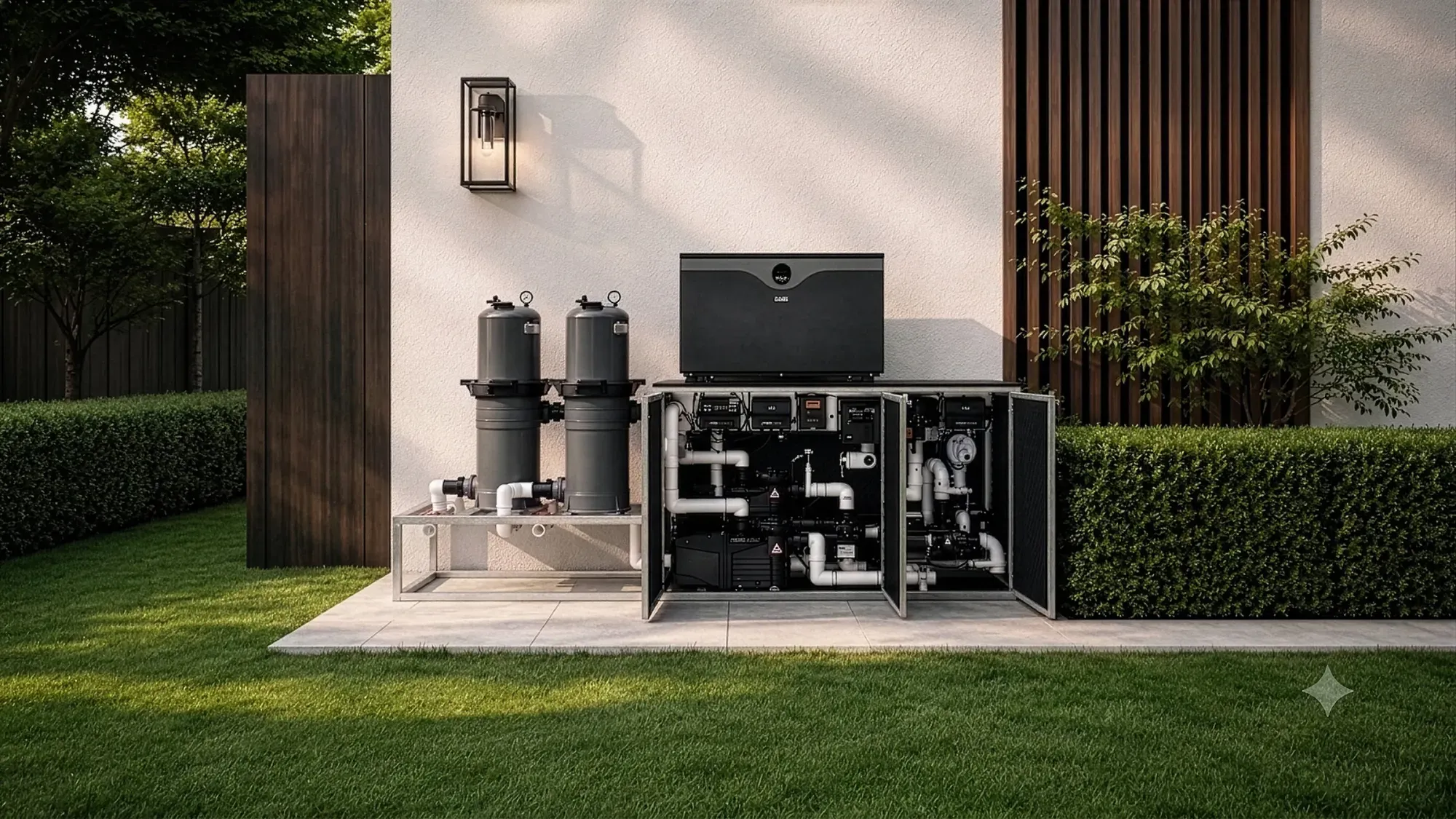
A Summertime pool comes with the HushHub Control system, a factory-built, pre-plumbed and pre-wired equipment hub that won a SPASA Product of the Year award in 2025. It carries a 5-year warranty and houses everything in one acoustically enclosed unit: pump, filter, chlorinator, and optional heat pump.
Variable Speed Pump: Your Biggest Decision
If you're choosing between a single-speed and a variable speed pump, this is not a close call: the pool pump circulates water through the filter system, so its efficiency matters every day. A single-speed pump costs around $800. A variable speed costs around $1,600. The variable speed saves approximately $800 per year in electricity costs, which means it pays itself back within 12 months. Variable-speed pumps can reduce energy use by up to 70%. Every year after that, you're $800 ahead.
In winter, when you're running the pool at a lower cadence, the variable speed pump lets you dial back to a slower circulation without switching off entirely. In normal season conditions, a standard pump should run 10-12 hours daily. That's how you maintain water quality year-round without running up an unnecessary power bill.
Filter Type Matters
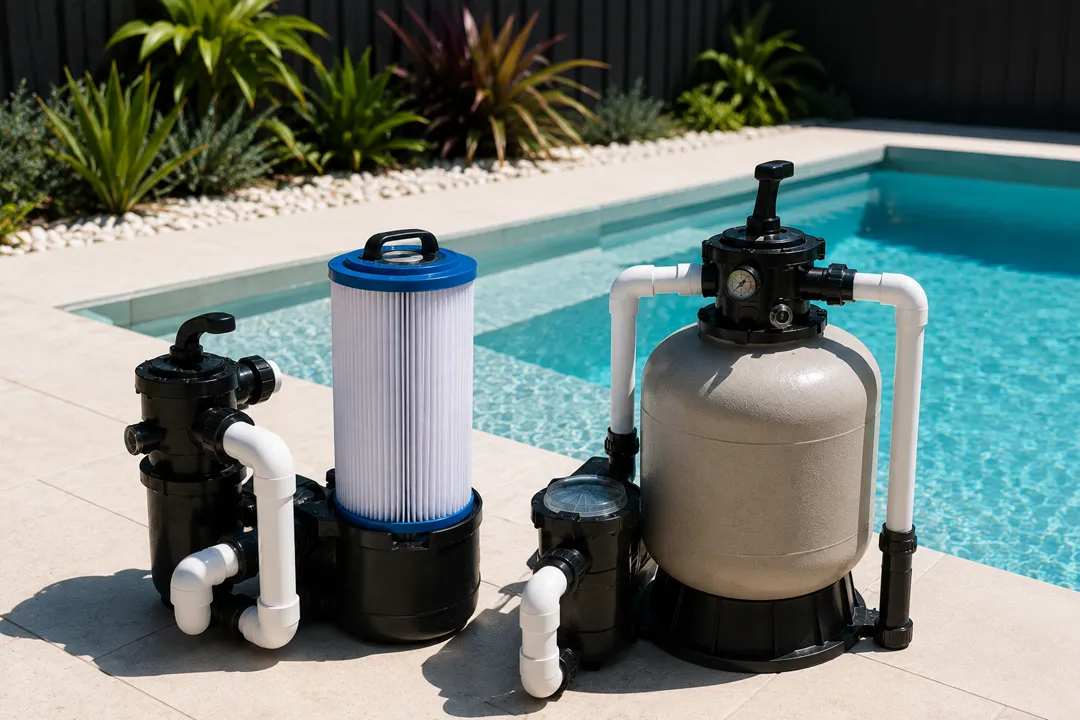
A cartridge or micro filter is preferable to a traditional sand filter. Sand filters require backwashing to clean, which wastes hundreds of litres of treated, chemically balanced pool water every time. Cartridge filters on the other hand clean without backwashing. Given the cost of chemicals and the time it takes to rebalance backwash-diluted water, the pool filter choice matters, and the cartridge filter is the smarter option. If you do have a sand filter, check the pressure regularly and backwash when it rises about 8-10 PSI above normal.
Reading Your Pressure Gauge
The pressure gauge sits on top of the filter. Under normal operation for a Summertime pool system, you should see around 40 kPa. Learn what your normal looks like from day one.
- High pressure (above normal): dirty filter or blockage between the pump and pool on the return side. Clean your filter cartridges.
- Low pressure (below normal): restriction between the pool and the pump on the inlet side. Check skimmer basket for leaves, plastic, or debris. Otherwise check for a low water level.
- Poor vacuum suction: also a sign of low pressure at the pump inlet - clean the skimmer basket first.
Heat Pump: Keep It Under 30°C
Most people use a pool heater such as electric heating rather than solar heating via solar roof collectors. Solar heating has almost zero running costs once installed. Important: keep pool water below 30°C. Above that temperature, if you're on a mineral water system, magnesium can begin to solidify and leave sticky residue and stain on pool walls. More critically, no heat pump manufacturer in the world will honour a warranty on a unit running pools above 30°C. If you want spa temperatures, look to buy a spa or one of our Daylesford or Peninsula pool spa combination pools.
If you do have solar roof collectors, inspect them at the start of each swim season: frost can cause pinholes in the black rubber matting in Victoria. Pool water is corrosive (salt and minerals) and will rust out roof fittings quickly. If tradies have worked on your roof during the year, check nothing was stepped on or damaged.
The HushHub in Winter
At the end of swim season, clean the internals of the HushHub unit thoroughly. During excavation and installation, the unit is exposed to the ground so insects, particularly in Queensland, will find their way into any small gap. Apply a surface spray barrier around the base of the unit (not inside it) to deter pest nesting over winter.
4. Pool Maintenance and Water Chemistry: The Clean-Test-Balance Routine
Barry Mackay has been asking people to do three things in the same order for over 20 years: Clean. Test. Balance. In that sequence. Never the other way around.
Here's what each step actually means:
"If you actually smell chlorine at your pool, your pool is over-chlorinated. A properly balanced pool has no odour."
- Barry Mackay, Service Manager, Summertime Pools
Step 1: Clean
Cleaning must come first because debris affects test results. Skim floating debris daily to help prevent staining the pool shell. Clean your skimmer basket, pump basket, filter cartridges, and pool surfaces with a pool brush and vacuum before taking any water sample. A dirty pool will consistently give you inaccurate readings. Robotic cleaners can automate much of routine pool cleaning but manual cleaning is still required.
Step 2: Test
Get your water tested at your local pool shop by going in person with a sample from elbow-depth, not the surface. Do this fortnightly during swim season and monthly in the off-season, and use simple at-home methods such as the strip-testing approach shown in Summertime's guide on how to test your pool water to stay on top of levels between shop visits.
For home dip strip testing: if your dip strip reads blank or shows no colour on the chlorine indicator, the pool isn't low on chlorine, it's so over-chlorinated it's bleached the indicator. This is the dilution test Barry recommends:
- Fill a cup with pool water from elbow-depth.
- Tip out half and top up with fresh tap water.
- Dip the strip and check the reading.
- If still blank, tip out half again and top up with more tap water.
- Keep halving until you get a readable number, then multiply back up to calculate the actual chlorine level. ie Dilution #4 is 16x diluted.
A properly maintained fibreglass pool needs just 1 part per million (ppm) of chlorine. If your dilution test shows you're at 25 ppm, you're 25 times over target. Use sodium thiosulphate (sold as 'chlorine down' or 'chlorine remover') to bring it back.
Step 3: Balance
Once you have accurate readings, adjust in this order with water balancing chemicals: alkalinity first, then pH, then chlorine. This is the sequence because pH and chlorine readings are unreliable until alkalinity is within range (80-120 ppm), and pool size and pool volume affect dosing as larger pools need more product to reach the same balance point. Always give the chemicals time to circulate, at least an hour, before testing again. In practice, balancing chemicals are central to maintaining a healthy pool.
The Biggest Mistake: Heavy-Handedness
More is not better with pool chemicals. High pH + high chlorine is the single biggest enemy of your fibreglass shell. When chlorine and pH rise together, which they often do (high chlorine drives pH up with it), the result is sodium hypochlorite: the same thing used to bleach stone-wash jeans. It will etch and bleach your gelcoat surface over time. Damage done this way is progressive, expensive to repair, and voids surface warranties.
High chlorine also destroys pool blanket bubbles, eroding the cells that provide insulation and reduce evaporation. Pool blanket manufacturers will not warranty damage caused by excessive chlorine levels.
CRITICAL RULE: Never put oxidiser (chlorine shock) into a pool with a cover on it. The gas build-up can damage both the cover and the pool surface. Always remove the cover, add chemicals to a running pump, and leave the cover off for a minimum of 4 hours.
Understanding Evaporation - Not Every Water Drop Is a Leak
In hot, windy conditions, which Victoria and Queensland both experience regularly, you can lose 8-12mm of water per day from evaporation alone. In a 10-metre pool with 42,000 litres, that's several hundred litres over a week. Factor in swimmers exiting the pool as well since a full-grown adult carries approximately 4 litres of water off their body when they get out. Before you call for a leak test, check your water level over 24 hours with the pump off and the pool covered.
5. Your Pool Shell: How Long Will It Actually Last?
Summertime Pools guarantees the fibreglass shell for 25 years. Fibreglass pools installed in the 1970s are still in service since the material doesn't degrade in the way concrete does. But what does age is the gelcoat surface, and that's entirely within your control.
The Old Problem: Osmosis
Early fibreglass pools had an osmosis problem as groundwater could penetrate the outer layer of the shell, causing delamination from the outside in. You'd see bubbles or blistering on the shell interior over time.
That problem is largely solved in modern pools. Summertime fibreglass shells are waterproofed from both inside and outside, eliminating the groundwater penetration pathway. The vinyl ester resin gelcoat technology Summertime uses sits at the leading edge of the industry.
The Current Threat: Your Own Chemistry
The primary threat to a modern fibreglass shell is the owner's own water. High pH combined with high chlorine attacks the ChlorShield gelcoat, Summertime's proprietary surface protection system, over time. Winter is when most of the damage occurs, because the pool is 'out of sight, out of mind' and chemical levels drift without correction. Cloudy water can be an early sign of algae growth. Where appropriate, algaecides can be used as a preventive treatment.
Barry's real-world example: a customer handed over their pool in early December. They fitted a cover and didn't check the water until well into the new year, over a month unmonitored. The chlorinator had continued dosing into a covered, unchecked pool. When the cover came off, the chemical levels were dangerously high, and the gelcoat had been under sustained chemical attack the entire time.
Metallic Staining: A Simple Warning
Never leave metal objects on the fibreglass surface. A bobby pin, a hair clip, a metal toy or any ferrous metal that sits in contact with the gelcoat will begin rusting immediately. The resulting rust stain bonds into the surface and is extremely difficult, sometimes impossible, to remove without professional treatment. Keep it off the surface entirely.
"Your pool is permanent. You can't trade it in like a Mercedes when you want something new. Look after what you've got."
- Barry Mackay, Service Manager, Summertime Pools
For comparison: removing an old concrete pool costs upwards of $25,000. A fibreglass shell that has been looked after correctly simply doesn't need replacing.
6. Winter Routine: Your Pool Is Not a Reptile
"Swimming pools are not reptiles and should not be hibernating in winter."
- Barry Mackay, Service Manager, Summertime Pools
Shutting your pool down for winter is one of the most expensive mistakes a pool owner makes. The pump should run every day, year-round. What changes is the cadence, not the habit.
Transitioning Into Winter (End of Swim Season)
- Do a full clean, from skimmer basket, pump basket, filter to pool surfaces.
- Get a water test done at your pool shop. Establish a clean chemical baseline before the quiet period.
- Dial all settings down: reduce pump running hours, reduce chlorinator output. Your variable speed pump handles this without switching off.
- Check the atmosphere pipe and pump out any accumulated groundwater.
- If you're in Victoria with solar roof collectors, disconnect or check for frost damage before winter sets in.
- Apply a surface spray pest barrier around (not inside) the HushHub base unit.
During Winter: Monthly Minimum
Check monthly. Don't skip. Winter is when most chemical damage happens, not because people are using the pool too little, but because nobody's checking it.
- Check skimmer basket and pump basket for leaves and debris as they accumulate even with a cover on.
- Check atmosphere pipe as groundwater levels can rise significantly after rain.
- Get a full water test monthly in winter - the minimum. Don't rely on dip strips alone; go to the pool shop.
- Watch for tannin staining. If you have overhanging trees and the pool is covered, tannin from organic debris can stain the fibreglass surface. A monthly visual check catches this early.
- If you're going away for an extended period, you can extend to two months between tests, but this is not ideal. Don't leave a pool completely unmonitored for more than 8 weeks.
Queensland vs Victoria: Same Routine, Different Duration
If you're in Queensland, the pool maintenance routine is fundamentally the same as Victoria, but you run it for slightly longer each day because warmer ambient temperatures create higher chlorine demand and greater evaporation. In the northern states, you may also find yourself running the heat pump in cooling mode during peak summer to bring water temperature down below 30°C. Wildlife interaction, cane toads in particular, are a constant issue in Queensland. Check pool and skimmer baskets more frequently.
7. Spring Check In: Getting Pool-Ready After Winter
Barry's spring routine is straightforward: clean, test, dial back up. That's it. But the order matters.
Spring Checklist
- Full clean: skimmer basket, pump basket, filter cartridges, pool surfaces, vacuum the floor.
- Professional water analysis at the pool shop, not just a dip strip.
- Balance the water in the correct sequence: alkalinity, then pH, then chlorine.
- Increase pump running hours back to summer levels (enough for 1.5 turnovers per day, the legal requirement for domestic pools in Australia).
- Turn chlorinator output back up.
- If you have a heat pump, turn it on and dial up to your target temperature.
- If you have solar roof collectors, turn the system back on and check for frost damage: pinhole leaks in the rubber matting. Check any roof pipe fittings as well.
- Test the water again after 24 hours of circulation before anyone swims.
The reason for a second test before swimming is simple: the law requires that pool water be safe to accidentally swallow without causing illness. As Barry puts it: "The whole objective of the HushHub system is that it's a water treatment plant. Realistically, if I accidentally swallow that water, I'm not to get sick." Get the chemistry right before you let people in.
BARRY'S SUNDAY MORNING HABIT: Cup of coffee. Take the cover off. Visual check of the water clarity and surface. Test the water. Make adjustments if needed. 20 minutes, once a week. That's all it takes to stay ahead of every issue a pool can throw at you.
8. Pool Maintenance Costs: What It Costs to Run a Fibreglass Pool
Based on a 10-metre Summertime pool (approximately 42,000 litres) with a Chilli Fresh 280 salt chlorinator, Chilli Sonic variable speed pump, and 24kW heat pump, located in Victoria:
Pool Maintenance Cost BreakdownCostAnnual chemicals (diligent owner)$300 - $400Annual electricity - pump + chlorinator$350 - $550Combined annual running cost~$700 on averageElectricity rate (Melbourne)28-32 cents/kWhVariable speed pump payback period~12 months vs single-speed
These figures are from Barry Mackay's own experience quoting and servicing Summertime pools, not industry averages. They assume diligent testing (monthly in winter, fortnightly in summer), a pool blanket to reduce chemical evaporation, and correct use of a variable speed pump. Broader pool maintenance costs and other ongoing costs for a residential pool often work out to about $100-$200 monthly or $600-$1,500 as an annual cost, depending on setup and service level. Chemical costs alone commonly range from about $40-$120 per month, and those maintenance costs shape the total cost alongside pool running costs, with actual spend driven by pool size and testing habits.
What blows out the budget: abandoning the routine. Owners who test only two or three times per year typically spend three to four times more on chemicals. Not because fibreglass is expensive to maintain, but because uncontrolled chemistry creates problems that require expensive correction. High chlorine that's been sitting for months does damage that costs far more than the chemicals used to prevent it.
One More Hidden Cost: Undetected Leaks
If your chemical budget starts creeping up significantly, and you're spending more at the pool shop but the water still doesn't look right, check for a minor leak before buying more chemicals. Chemical demand also varies by pool type, so factor that in before assuming a leak. The most common culprit is a hydrostatic valve: the safety release valve at the pool floor that opens under groundwater pressure. If it doesn't reseat correctly after a high-water table event, it creates a slow, steady leak that dilutes your chemicals continuously. An auto water leveller masks this entirely because the pool stays full, so you only see it in your escalating chemical spend.
9. DIY vs Professional: Know Where the Line Is
Summertime Pools teaches every new owner how to maintain their pool at handover. DIY pool care usually takes 1-2 hours a week for cleaning and checks, so the boundary between what you should handle yourself and what you should leave to a professional is clear. A professional service typically costs $77 to $145 per visit, but the right routine can also save money.
Owner Responsibilities
- Clean the skimmer basket, pump basket, filter cartridges, pool surfaces (brush and vacuum).
- Test fortnightly in swim season, monthly off-season. Pool shop for full analysis.
- Balance chemicals as directed. Follow the clean-test-balance sequence.
- Adjust pump running hours and chlorinator output seasonally.
- Check atmosphere pipe regularly - dipstick check, transfer pump for any accumulated groundwater.
- Visual inspection of water clarity, pressure gauge, solar roof collectors, HushHub base.
Call a Professional For
- Anything involving electrics - never attempt electrical work on pool equipment yourself. Get professional help for any complex replacement work or equipment installation.
- PCB board replacement on controllers or heat pumps.
- Suspected leaks, particularly hydrostatic valve issues or pipe work. A green pool may need professional recovery when normal balancing and cleaning are no longer enough.
- Gelcoat repair or surface treatment.
- Routine pool cleaning visits (commonly $77-$145 per visit) - the fastest way to recover after major water-quality problems.
- For any warranty claim, always contact Summertime Pools first before attempting a repair.
A note on chemical storage: if you have young children, don't stockpile chemicals at home. This is exactly why salt chlorination exists. The system generates chlorine on-site from salt in the water, eliminating the need to store bulk oxidisers. Buy what you need, when you need it.
10. Quick Reference: Your Annual Pool Calendar
October (Spring Startup)
Full clean, full water test, increase pump hours and chlorinator output, solar collector check, test again before swimming.
November - March (Swim Season)
Fortnightly water test at pool shop, clean-test-balance routine, keep the pool cover on when not in use to reduce evaporation and chemical loss, fortnightly atmosphere pipe check, no metal objects on surface.
April (Autumn Wind-Down)
Full clean, water test, reduce pump hours and chlorinator output, solar collector check/disconnect if VIC.
May - August (Winter)
Monthly water test at pool shop, monthly atmosphere pipe check, monthly skimmer/basket clean, good quality pool cover to cut heat loss and lower electricity bills, pest barrier check on HushHub.
September (Pre-Spring Prep)
Full clean, full water test, order any chemicals needed for season startup.
About the Author.